

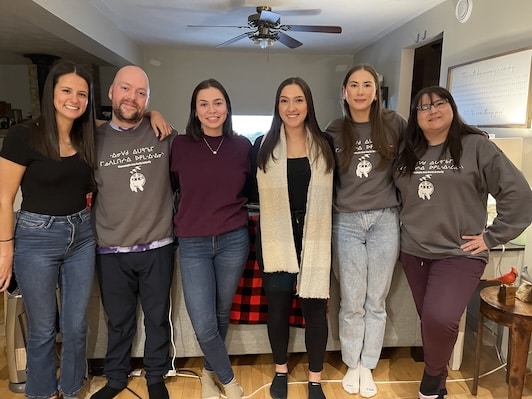
Ykiskinohtahiwewak, derived from the Moose Cree language meaning “they who show the way,” is a program revolutionizing the recruitment and retention of healthcare professionals from the western James Bay and Hudson Bay region. Established in 2021, the kiskinohtahiwewak program, or kiskino for short, focuses on increasing the representation of First Nations healthcare providers from the region working for the Weeneebayko Area Health Authority (WAHA).
The beginning of kiskinohtahiwewak
In 2021, Dr. Max Boulet, a resident physician, and Justice Seidel, a Moose Cree First Nation member and community-based researcher, both working for WAHA, discovered their shared vision of increasing the number of local First Nations physicians serving the region’s communities. With a population of approximately 12,000 people, to date, only two local First Nations community members have ever returned to the Weeneebayko region to practice medicine. This realization led to the birth of the kiskinohtahiwewak program.
kiskino’s first outreach events took place in 2022 at high schools in the Ontario communities of Moosonee and Moose Factory. Students were provided hands on learning experiences through interactive activities like practicing CPR and pediatric first aid techniques. The Northern Ontario School of Medicine University, Queen’s University and the University of Toronto all gave presentations on the various medical programs offered at each of their schools.
Community mentorship
Mentoring resources are often lacking in rural and remote First Nations communities. kiskino’s unique approach uses a mentor and mentee model with students from high school through post-secondary and graduate school/medical school. Mentors are paired with mentees from the same community to build relationships based on shared cultural understanding and show mentees a successful career in healthcare is achievable. Mentors help student mentees navigate competitive application processes for healthcare programs and provide ongoing support throughout the mentees’ academic journey. Many mentees become mentors to the next wave of high school students interested in healthcare careers.
Success stories and future goals
Over the past three years, kiskino has engaged more than 500 students through outreach events that provide hands-on healthcare experiences, aiming to inspire and guide them towards medical careers. Currently more than 20 people are being mentored in nursing, medicine, and physiotherapy. In the long term, kiskino has set a target of 50 per cent of all WAHA medical staff being First Nations community members from the region in the next decade.
Justice Seidel’s journey epitomizes kiskino’s impact. Initially unaware of her potential for a career in medicine, Seidel’s collaboration with Dr. Boulet and later mentorship led to her application and acceptance into the Northern Ontario School of Medicine University (NOSM University). Now a second-year medical student, Seidel, has signed a return of service agreement to practice as a family physician with WAHA after graduation.
“The essence of kiskinohtahiwewak is rooted in uplifting community members to achieve their full potential in a culturally supportive way. This is modeled by my own experience of being mentored and encouraged by Dr. Max Boulet in a way that respected and valued my cultural and lived experience as a First Nations person, which led to my admission into medical school. The collective success of kiskino is further strengthened by the work and perspectives of the rest of our leadership and advisory circles, making this program truly rooted in community,” said Justice Seidel, kiskino mentor and second-year medical student at NOSM University.
The kiskinohtahiwewak program is a pioneering initiative in Canada, driven by First Nations community members for the benefit of their own communities, marking a significant step forward towards equitable healthcare representation and service in the western James Bay and Hudson Bay region.
The Weeneebayko Area Health Authority (WAHA) provides acute and ambulatory healthcare services to communities along Ontario’s western James Bay and Hudson Bay coasts. We serve over 12,000 people through hospitals in Moose Factory, Fort Albany, and Attawapiskat, and a health centre in Moosonee. We also operate regional outpatient programs, as well as paramedicine services throughout the region, including in Kashechewan and Peawanuck. WAHA is affiliated with Queen’s University.
By Tara Hutchison, Justice Seidel, and Heather Ross