

HN Summary
• AI-powered screening tool: Researchers at UHN developed the Hypermobility Assessment Tool (HAT), an AI-driven smartphone app approved by Health Canada that uses a phone camera to measure joint flexibility and automatically generate a Beighton Score to screen for Ehlers-Danlos Syndromes (EDS).
• Improving accessibility and accuracy: The app simplifies the traditionally manual Beighton Score test—often done incorrectly or not at all by family physicians—making it easy for clinicians and patients to perform accurate hypermobility screenings without specialized equipment or training.
• Empowering patients and physicians: By providing an accessible, validated screening option that correctly identified over 91% of positive cases in trials, HAT aims to reduce misdiagnosis, ease unnecessary referrals, and help patients with EDS get faster, more accurate care.
A new app offers doctors and patients a more accurate and accessible screening test for Ehlers-Danlos Syndromes (EDS).
The app, called the Hypermobility Assessment Tool (HAT), is an AI-powered tool that uses a smartphone camera to screen for double-jointedness, a key attribute of EDS. Health Canada has approved it as a clinical screening tool.
Dr. Nimish Mittal, Co-Medical Director for the Ehlers-Danlos Syndrome Program at UHN’s Toronto General Hospital, and Dr. Babak Taati, a Senior Scientist at UHN’s KITE Research Institute, led the team that created the app.
Part of their motivation was a sharp increase in referrals to Dr. Mittal’s clinic that mirrored a rise in public awareness of the disorder. On social media sites like TikTok, EDS advocates have shared their struggles, successes and symptoms of the syndrome, successfully raising its profile.
But that increased visibility hasn’t always translated into better care. “Because it’s a rare disorder, people with EDS are often told their symptoms are from fibromyalgia, or that it’s all in their head,” says Dr. Mittal. “By putting an easy-to-use hypermobility assessment tool in the hands of clinicians and patients, we hope to empower both physicians, who don’t have enough knowledge about the disease, and patients who are concerned that they might have this disorder.”
EDS is a genetic connective tissue disorder that causes pain, chronic fatigue, organ issues and even, in rare cases, death. Its hallmark feature is hypermobility, or double-jointedness.
Healthcare providers assess hypermobility with a Beighton Score test. In it, healthcare providers measure the angle of people’s joints while they are doing specific movements, such as straightening their elbows. People who get a higher score are likely to have generalized joint hypermobility and are referred to specialists to determine if the root cause is EDS or something else, like Marfan syndrome.
Traditionally, healthcare providers either visually assess the patients for this test or use a small plastic tool to measure the angles. That can be difficult to do correctly, says Dr. Mittal, and many family physicians don’t even know the score exists.
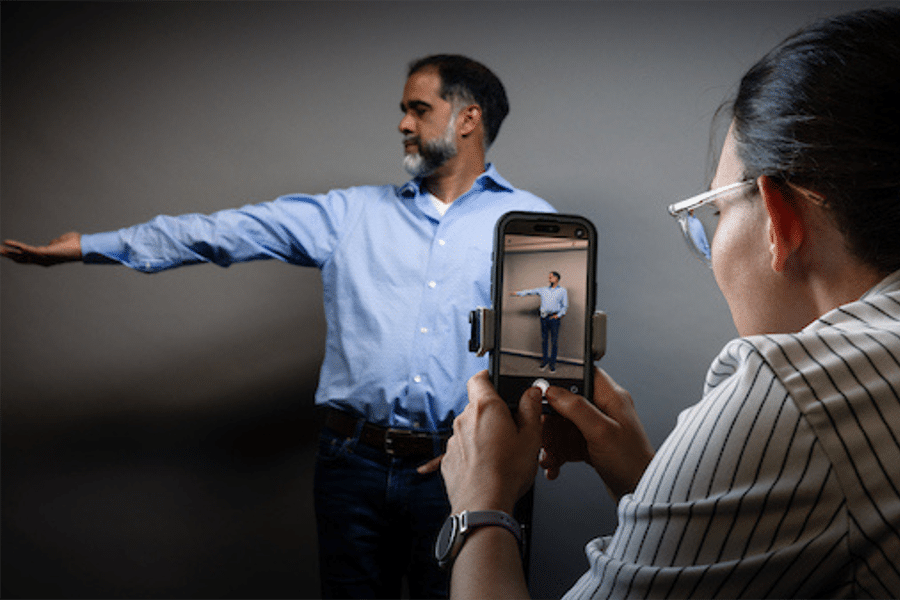
HAT aims to change that. The app guides people through the nine movements in front of their phone’s camera, then returns a Beighton Score using AI. It’s simple enough that healthcare providers—or patients themselves—can do it without training.
“Family doctors may not even know this test exists, may not have the device to measure the angles correctly, or may not know how to do it,” says Dr. Mittal. “This solves all those problems by automating the screening and the scoring, and it gives more power back to people concerned they might have this disorder to screen themselves.”
KITE senior scientist Dr. Taati led the technical side of the project, along with KITE research associate Andrea Sabo. They started by reviewing existing pose tracking models, but found that they weren’t accurate when measuring hyperextended joints. “That led us to train and validate our own pose tracking models instead,” says Dr. Taati.
He trained a new model on around 100 people and then studied the accuracy of the screening technology in the app on 125 people with suspected generalized joint hypermobility who had been referred to Dr. Mittal’s clinic. That research, which has been submitted for publication, found that it correctly identified 91.9% of positive cases.
The team is now studying how the app-generated Beighton Scores stack up against scores from healthcare providers in the clinic.
Having a new, highly accessible screening option for EDS will benefit both patients and healthcare providers, says Dr. Mittal. “We hope this app will reduce unnecessary anxiety and referrals for those who do not have the condition, and shorten the long path to diagnosis for those who do.”