
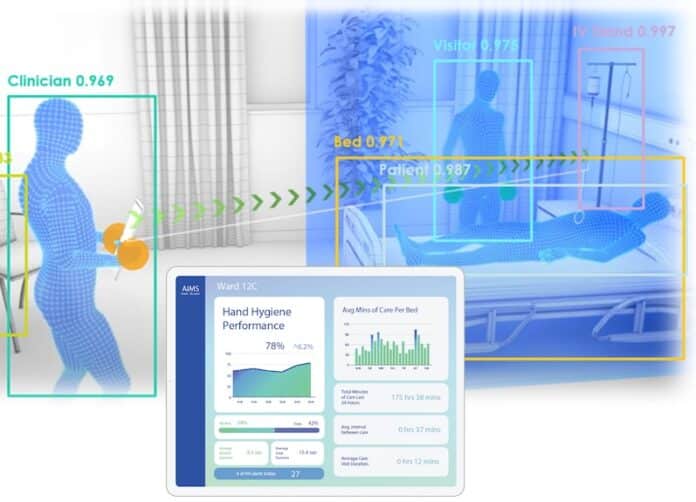

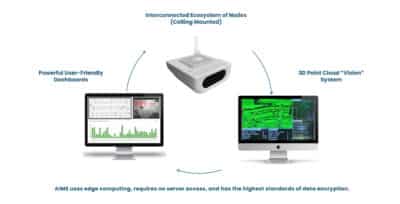
The Ottawa Hospital (TOH) is the first in Canada to implement the Artificially Intelligent Monitoring System (AIMS) to understand and improve hand hygiene. AIMS is a Perception-Action AI platform technology that unites AI and 3D sensors, providing real-time feedback and generating predictive insights – helping improve hand hygiene compliance and enhance patient safety without using cameras or collecting personal data.
Early results have been significant
TOH installed AIMS in 2023 in a Transitional Care Unit (E5) at the Civic Campus. AIMS nodes were installed in patient rooms and hallways, first collecting baseline data before activating real-time reminders.
When someone cleans their hands, AIMS assesses the duration and quality, which is signalled by a pulsing blue light. If someone approaches a patient without cleaning their hands, AIMS provides a proactive ‘nudge’ – a yellow light and soft chime – as a reminder. AIMS captures this data in real time and makes it available to unit managers and staff through a dashboard to track their hand hygiene practices. AIMS provides the equivalent of seven years of hand hygiene data daily compared to traditional human auditors.
The results have been significant. The E5 Unit at TOH saw a 27 per cent sustained, relative increase in daily hand hygiene events. There were no outbreaks in the 12 months after AIMS was implemented, which is particularly notable given that staff in E5 care for vulnerable populations who may be at higher risk for outbreaks and serious illness.
The technology has been embraced by patients, visitors and clinical staff with zero complaints.
“We have positive feedback from our staff, our patients and our family members,” said Sybile Delice-Charlemagne, Clinical Manager at TOH. “When they understand what it does, they’re like, ‘Wow, that’s great that the hospital is taking a step to keep my loved one safe.”
Frontline health-care workers have shared positive feedback regarding the integration of AIMS into their daily routines. Nurses say AIMS has become an essential tool in promoting patient safety and reducing the risk of infections.
“It’s really been helpful in ensuring staff compliance with hand hygiene protocols,” said Colleen Menary, a Clinical Care Leader with TOH. “It’s like having a colleague that’s there to just give you a gentle nudge when you need a reminder on some things.”
Hand hygiene is a key factor in reducing hospital-acquired infections
Hospital-acquired infections (HAIs) are a serious issue in health care. According to the World Health Organization, 70 per cent of these infections are preventable with proper hand hygiene, but ensuring consistent compliance can be challenging.
The Public Health Agency of Canada estimates that HAIs affect more than 200,000 patients annually and result in approximately 8,000 deaths annually.
“The Ottawa Hospital is committed to finding innovative solutions to health-care challenges and has actively integrated AI to improve patient care and operational efficiency,” said Suzanne Madore, Chief Operating Officer and Chief Nursing Executive at The Ottawa Hospital. “We recognized AIMS’ potential for hand hygiene during the COVID-19 pandemic and are impressed by the continued improvements since our collaboration began.”
The Ottawa Hospital is expanding AIMS use to other areas
AIMS is more than just a solution for hand hygiene, it also has the potential to address other patient safety challenges. Building on the successful implementation of AIMS for hand hygiene, TOH is currently planning to leverage AIMS for detection and prevention of falls.
Through strong collaboration with Canadian technology firm Lumenix, Lumenix, TOH will continue to explore innovative uses of the AIMS technology, ensuring ongoing improvements in patient care and operational efficiency and enhancing the overall patient experience.