

For individuals recovering from a stroke or spinal cord injury, restoring hand and arm function is essential to regaining independence.
Robot-assisted therapy is an emerging rehabilitation tool that offers consistent and precise movement training. However, its real-world applicability remains limited due to variability in hand use during daily activities outside clinical settings.
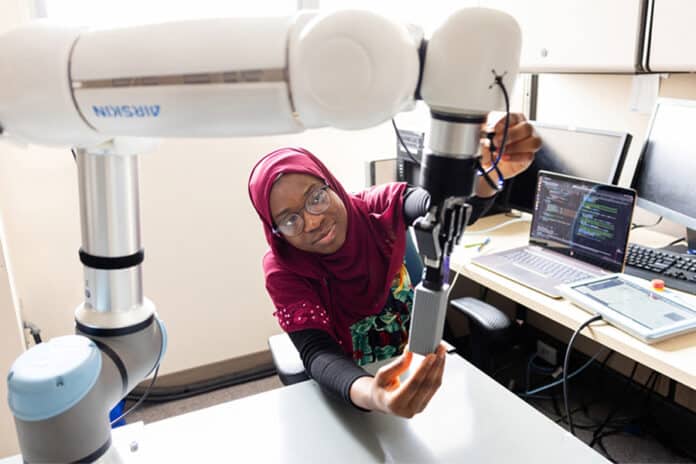
Researchers from UHN’s KITE Research Institute are addressing this challenge by integrating real-world objects into robot-assisted therapy.
The research team, led by Dr. Milos Popovic, senior author of the study, Senior Scientist and Director of the KITE Research Institute, and a professor and Director of the Institute of Biomedical Engineering at the University of Toronto, adapted a common clinical assessment tool — the Toronto Rehabilitation Institute-Hand Function Test (TRI-HFT) — for use in robot-assisted therapy.
Traditionally, the TRI-HFT involves manipulating everyday objects that require different grips, including a mug, a sheet of paper, a book, a credit card and a pencil. By redesigning these objects for robotic compatibility, the team enabled the robotic arm to interact with them, allowing the test to be used during therapy.
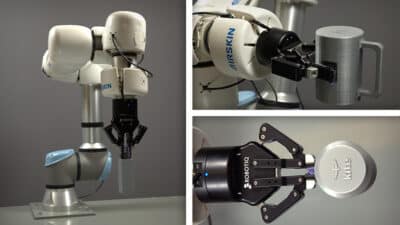
The team redesigned and 3D-printed 11 TRI-HFT objects. Testing demonstrated that the robotic arm successfully picked up and moved each object, achieving a 100 per cent success rate.
Additionally, five participants with normal arm and hand function evaluated the system’s safety and usability, reporting that it was comfortable, engaging and easy to use.
By combining advanced robotics with traditional rehabilitation tools, this approach enhances the functionality, personalization, and real-world application of robot-assisted therapy.
Modified, 3D-printed TRI-HFT objects and the robotic arm gripping them. (Phots: UHN’s KITE Studio)
The research, whose co-author is Dr. César Márquez Chin, scientist at the KITE Research Institute and a faculty affiliate at the Institute of Biomedical Engineering at the University of Toronto, explores a new approach to robotic rehabilitation and the findings lay the groundwork for more effective recovery strategies and improved long-term outcomes.
Future research will explore broader clinical applications and adaptability across different robotic systems.