

In a stress-filled world, people everywhere are chasing a decent night’s rest, fuelling a global sleep-aid industry worth more than $1 billion.
Today’s “sleep crisis” is often driven by circumstances beyond our control, such as exploitative labour conditions or shift work, says University of Alberta political scientist Cressida Heyes.
Whatever the reasons, she says, in many ways it has become the “new sex.”
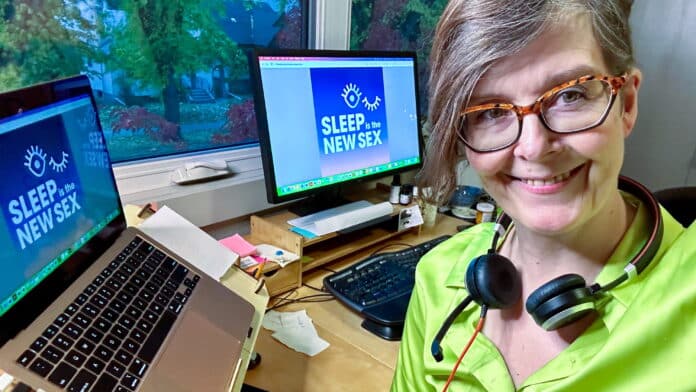
To unpack the meaning of sleep in our lives and how it is culturally represented, Heyes has launched a new podcast called Sleep is the New Sex, an extension of her long-term research project on the topic designed for a popular audience.
With the help of political science doctoral student Joshua Ayer and Tom Merklinger of the Sound Studies Institute, the podcast explores how our notions of sleep reveal complex constructions of gender, identity, sexuality, work and the economy. In some ways, says Heyes, it’s a symbol for everything that’s wrong with our lives.
“It has taken over from sex, or at least is alongside it, as a subject of tremendous cultural anxiety. Are other people getting more and better? Am I doing it right?
“We’re trying to get underneath the superficial layer of sleep anxiety to say, what’s it really about?”
Each episode of the podcast features a different guest expert and covers a range of topics including beauty sleep, sleep coaching, working from bed, sexual violence and “cultures of fast and slow.”
“Research suggests that more people — especially more women — crave sleep than sex, and sleep has taken over from sex in the popular imagination as a topic for cultural anxiety and thwarted need.
“In an era of sexual saturation but widespread exhaustion, sleep is a prime target of desire.
She also points to a curious feature of this manosphere moment, whereby some men believe sleep deprivation signifies masculinity, a phenomenon sometimes referred to as “sleep machismo.”
One 2021 study found that even as the sleep industry booms, many men are not getting enough sleep, often sacrificing it to appear — if only to themselves — as more assertive and in control.
“Some elite men are still interested in telling us they don’t sleep and that this is a sign of virtue,” says Heyes.
“There is this hustle and grind mentality that just won’t die,” she says, “that we should all work ourselves into an early grave in the prospect of some kind of economic or personal success.”
As a feminist philosopher, Heyes became interested in the cultural politics of sleep when she experienced a severe deficit of her own — “falling apart,” as she puts it — after giving birth to her first child.
“I became incredibly confused and unreliable, unable to see a story or even a thought through from beginning to end,” she told Folio in 2016. “Every task was difficult. I can see why sleep is a central technique of torturers.”
She wrote about sleep in her award-winning 2020 book Anaesthetics of Existence: Essays on Experience at the Edge and has pursued her inquiry ever since, becoming increasingly convinced of the role of slumber in maintaining our very sense of self. Describing it as “like a little death,” she says for many it is the closest thing we have to regularly surrendering our ego.
“Sleep provides an opportunity to untether yourself from individuality. In western culture, we’re constantly told the goal of all of our self-making is to be an individual … but that is belied by sleep, because you lose control over yourself.
“You sort of merge with oneness, which is, of course, a part of many religions and spiritualities. Sleep (and dreaming) is a small version of that. Sometimes people resist it, partly because they’re so attached to the idea that they have to be in control of their whole life.”