
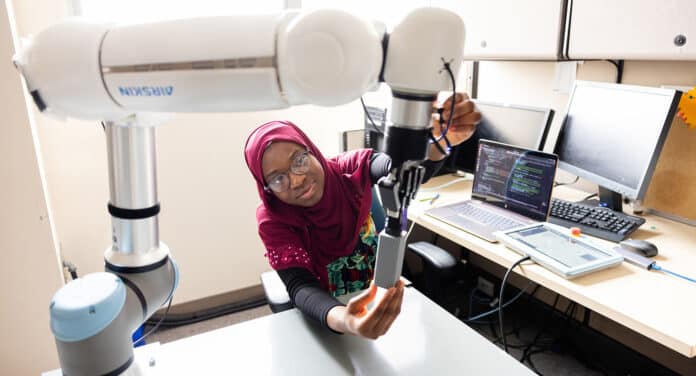

Aisha Raji overcame a lot in her first few weeks in Canada, from adjusting to living alone after growing up in a bustling household of five siblings to navigating the complexities of a once-in-a-lifetime pandemic, all while learning to build a robot on the fly for her PhD. But she says that paled in comparison to her biggest challenge: surviving her first winter.
Toronto’s weather is notoriously fickle. It can be 12 degrees one day and snowing the next – or sometimes both in the same day. Whereas her homeland of Ogun State in Nigeria is rarely dips below 20 degrees.
“I thought I was losing my mind,” said Raji, a KITE trainee and fifth-year PhD candidate at the University of Toronto’s Institute of Biomedical Engineering.
Raji is recounting her journey to KITE as part of the International Day of Women and Girls in Science (Feb. 11), an annual awareness event organized by the United Nations that aims to promote equal access and participation for women and girls in the fields of Science, Technology, Engineering and Mathematics (STEM).
“I hope by sharing my story I can inspire more women to enter STEM,” said Raji. “Everyone knows it’s a male-dominated field and from the outside, it can seem a bit daunting but once you get in you’ll see that the challenges are surmountable and you’re just as good as your male peers.”
As part of her innovative research, Raji is shifting the paradigm of robotic rehabilitation by developing software – and at times building hardware–for a robotic arm that provides therapy for individuals with upper extremity impairment (arms, shoulders, wrist, and hand) as a result of stroke and spinal cord injury.
The arm presents 3D-printed everyday objects such as a mug, phone, or credit card at various positions and angles within a patient’s reach for them to grab. Eventually, the robot presents these objects outside of their comfort zone. Therapists can work simultaneously with the robot, fostering an integrated rehabilitation experience.
“[Raji’s] research will allow therapists and robots to work together in an unprecedented way, making it possible to integrate the strengths each of them offers during rehabilitation,” said Raji’s PhD supervisor and KITE scientist Dr. Cesar Marquez-Chin.
Raji’s ultimate goal is to make this robotic arm portable and accessible worldwide. The arm would not only help patients do exercises but it would use data to tell them how they’re progressing in their rehabilitation journey and adapt the exercises to their
abilities.
“My grandma is the reason why I got into this field. When I was 13 years old she suffered a stroke. For the rest of her life she depended on my uncle and his family to do anything, eat, get out of bed, or just put on clothes,” said Raji.
“Seeing how she suffered and the toll it took on my uncle inspired me to build devices that could help individuals with stroke live a better life and be less dependent on the people around them.”
After completing her PhD, Raji hopes to enter the medical technology industry and use the expertise she’s gained here to help stroke survivors in her hometown.
Raji didn’t need to take a 8,892-km voyage across the world to pursue her dreams.
She could have easily stayed in her hometown and studied at the University of Ilorin – where her father is a professor – or chosen a field where she wouldn’t be one of the only women in her classes. But where’s the fun in that?
“These challenges are what makes life interesting and beautiful,” said Raji.